


Start with the count, because it decides everything downstream. Controlled human trials establishing a validated injectable GHK-Cu dose: zero. Not “limited.” Not “still emerging.” Zero properly powered dosing trials for the systemic, injected form of this peptide. Every milligram figure floating around a forum thread or a seller’s dosing chart has to be read against that number.
This piece runs GHK-Cu dosing claims through a fixed rubric, applies it evenly across routes, and shows the work. No route gets credit it hasn’t earned, and no route gets docked for reasons outside the evidence.
The rubric
Four questions, applied identically to every route:
- Does a controlled human study exist for this route at all?
- Is the flagship result peer-reviewed, or a conference proceeding?
- Has an independent RCT tried to replicate the effect, and what did it find?
- Does the evidence tie a specific dose to a specific outcome, or only a mechanism to a plausible outcome?
Answer those four honestly for each route and the grade falls out. No adjectives required.
The scored field
| Use / route | What’s actually dosed | Human dosing evidence | Grade |
|---|---|---|---|
| Topical (serum, cream) | Copper-peptide concentration in a leave-on product | Multiple controlled human skin studies spanning 20+ years, headlined by the Leyden facial-cream collagen result [C1] | B |
| Injectable, systemic | A reconstituted milligram dose, self-administered | No properly powered controlled human dosing trial identified [C3] | F |
| Oral / capsule | A swallowed dose | No controlled human GHK-Cu dosing trial identified; also faces digestion barriers | F |
Two rows fail outright. That’s not editorializing, it’s just what question 1 returns when you ask it of injectable and oral GHK-Cu: no controlled human dosing trial. A mechanism story is not a dosing trial, however good the mechanism story is.
Topical: the one row with a passing grade, and why it isn’t higher
Topical GHK-Cu has been measured on human skin for more than two decades, which is the only reason this row clears the floor. The number everyone quotes comes from a controlled facial-cream study by Leyden and colleagues: after a month, collagen production assessed via skin biopsy rose in 70% of women using GHK-Cu cream, versus 50% on a vitamin C cream and 40% on a retinoic acid cream [C1]. Review literature layers on additional reports of improved skin density and elasticity from topical use [C1][C2].
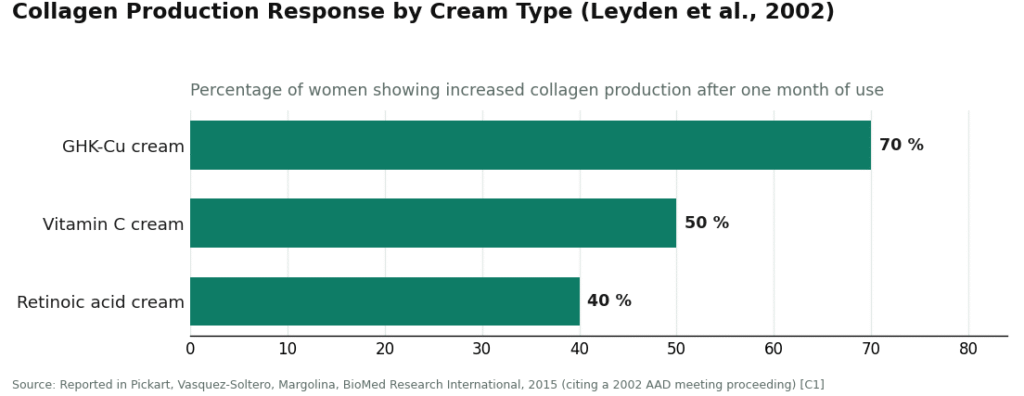
Run that 70/50/40 result back through the rubric and the B becomes clear rather than generous. Question 2: the 70% figure was presented at a 2002 American Academy of Dermatology meeting, a conference proceeding, not a peer-reviewed journal article [C1]. That’s a point off. Question 3: an independent RCT exists, and it did not replicate the win. Miller and colleagues, publishing in Archives of Facial Plastic Surgery in 2006, tested a topical copper tripeptide complex on CO2 laser-resurfaced skin and found no significant objective improvement in skin quality and no significant reduction in redness, despite higher patient satisfaction scores [C4]. Another point off.
So: real human data, a flagship result that isn’t quite peer-reviewed, and a documented null trial in the same file. That’s a B. Solid, not spotless, and not something to inflate into a general endorsement of the compound.
Injectable: why the F is not a temporary grade
The case for any specific injectable dose rests entirely on mechanism work, and the mechanism work is genuinely interesting. In cells and tissue, GHK-Cu increases collagen, elastin, and glycosaminoglycan production and touches a long list of repair, antioxidant, and inflammation-related genes, with one frequently cited review describing regulation of several thousand human genes [C1][C2]. A 2020 review in Aging Pathobiology and Therapeutics surveys GHK as an anti-aging peptide and is direct about where that evidence comes from: in-vitro and in-vivo studies, with the authors explicitly calling for further preclinical and clinical aging research [C3]. Read that sentence for what it says. The people closest to this literature are flagging the same gap this scorecard is built around. Nobody has run the human trial that connects a specific injectable dose to a specific human outcome.
Which means when a protocol quotes “1 to 2 mg per day for 30 days,” the precision is doing work the evidence hasn’t done. That number wasn’t derived from a dosing trial, because no dosing trial exists for this route. It’s an extrapolation from lab concentrations, scaled by someone’s judgment call. Judgment calls aren’t disqualifying by themselves, but they shouldn’t be mistaken for validated figures, and right now that’s the entire basis of every injectable protocol in circulation.
See also: Cloud Computing in Healthcare Systems
Two reading errors the rubric is built to catch
Borrowing the topical number for an injectable decision. The 70% collagen result is an on-skin, topical finding [C1]. It says nothing about injection dosing and nothing about whether injecting the compound works at all. Using a B-grade topical result to justify an F-grade injectable protocol is the single most common misread of this peptide, and it’s worth flagging every time it appears.
Reading dosing precision as dosing validation. A number with a decimal point looks like it came from a trial. Here, it didn’t. The accurate version of any injectable GHK-Cu dose claim is “an amount someone chose, unvalidated for safety or effect in controlled human research.”
There’s a third factor worth weighing alongside the rubric: copper itself. It’s biologically active, and the body regulates its balance tightly. That’s a materially different risk profile than applying a cream to your face, and it’s part of why the missing injectable dosing data isn’t a footnote so much as the headline.
Where supervision actually changes the equation
Anyone still weighing injectable GHK-Cu should be clear-eyed that they’re dosing into a gap the rubric can’t close. That’s precisely the situation where a clinician in the loop earns its keep. The supervised route runs through a licensed telehealth provider such as FormBlends, where a clinician reviews history, decides whether the compound is even reasonable for that person, a prescription gets written when it is, and a licensed pharmacy compounds and dispenses the product. Compare that with a website shipping a vial labeled “research use only” alongside a dose chart and no one accountable for the outcome.
To be precise about what supervision buys: it does not upgrade the F, because the underlying human dosing literature hasn’t changed. What it adds is a licensed person deciding what’s reasonable for a given situation, and being reachable if something goes sideways.
One concrete, measurable benefit worth naming: a record. People who log each dose alongside any skin or injection-site changes, for instance through the FormBlends tracker app, arrive at a clinician check-in with an actual timeline instead of a rough recollection. The app is a logging tool, nothing more, not a prescription and not a checkout. On a compound with this thin a human evidence base, an organized record of what was taken and what happened is one of the few things that can be measured, and it’s exactly what the research-chemical model skips, since that model ends at the shopping cart.
Final tally
Topical GHK-Cu: B. Real controlled human skin data, a flagship result that’s a conference proceeding rather than a journal paper, and a documented null RCT sitting in the same file [C1][C4]. Injectable and oral systemic GHK-Cu: F, both. Genuine mechanism data, no controlled human trial connecting a dose to an outcome [C3]. The rubric doesn’t move because a seller’s page is confident. It moves when a trial gets published.
Ask which row a given dosing claim belongs to before weighing it. And never let a topical B vouch for an injectable F.
The questions I get most
Is there an established “optimal” injectable GHK-Cu dose? No. Injectable systemic GHK-Cu scores an F on this rubric because no properly powered controlled human dosing trial has been identified for that route [C3]. Any milligram-per-week figure in circulation is extrapolated from cell and tissue studies, not validated in people, so its precision is borrowed, not earned.
Why does topical score a B while injection scores an F? Topical GHK-Cu has more than twenty years of controlled human skin studies behind it, including the Leyden facial-cream collagen comparison, which gives that row real numbers [C1]. Injectable use has only mechanism data, with no human study linking a given dose to a given effect [C3]. The grades reflect the amount of controlled human evidence behind dosing in each use, and that gap is wide.
Can the 70% collagen result justify an injection dose? No, and this is the error the rubric is built to catch. That 70% figure comes from an on-skin, topical cream study and says nothing about what to inject, or whether injecting works at all [C1]. Applying a B-grade topical finding to an F-grade injectable protocol is a category error, not a shortcut.
Is there a null result in the GHK-Cu file, or is it all positive? There’s a documented null. A 2006 randomized controlled trial of a topical copper tripeptide complex on CO2 laser-resurfaced skin found no significant objective improvement in skin quality and no significant reduction in redness, though patient satisfaction was higher [C4]. That result is part of why even the topical row lands at B rather than A.
Why does copper raise the stakes on an unsupervised injectable routine? Copper is biologically active, and the body regulates its balance carefully. A self-dosed systemic copper-peptide routine is a different proposition than applying a serum to the skin. That’s part of why the missing injectable dosing data isn’t a minor gap, and why having a clinician decide what’s reasonable carries real weight here.
Does going through a supervised provider make the injectable dose “validated”? No. Supervision through a licensed telehealth provider such as FormBlends does not upgrade the F, because the underlying human dosing data hasn’t changed. What it adds is a licensed person deciding whether the compound is reasonable for a given person, a prescription written when appropriate, a licensed pharmacy compounding the product, and a record of what was actually taken, none of which the research-chemical model provides.
What is GHK-Cu and what does it actually do in the body?
GHK-Cu is a naturally occurring copper peptide, glycyl-L-histidyl-L-lysine bound to a copper ion, produced by the body on its own. Levels fall noticeably with age. In lab and early clinical work it shows up in processes tied to wound healing, collagen synthesis, and antioxidant activity. Whether topical or injected doses meaningfully reproduce those effects in healthy adults remains an open question the research hasn’t settled.
How much GHK-Cu should I inject daily, and is there an established safe dose?
There’s no FDA-approved dosing protocol for injectable GHK-Cu, so no officially validated daily figure exists. Small pilot studies have used a wide range of amounts, and real-world dosing is largely extrapolated from that limited data. Anyone pursuing injectable GHK-Cu should do it through a physician-supervised compounding pharmacy, like FormBlends, rather than sourcing it as a raw research chemical, because purity, sterility, and dose accuracy vary enormously between those two paths.
Is GHK-Cu FDA approved?
No. GHK-Cu carries no FDA approval for any medical indication. It sits in a gray zone: used in some cosmetic formulations without drug-level approval, and occasionally compounded for off-label injectable use under physician oversight. The safety and efficacy data required for full drug approval simply hasn’t been generated yet, so anyone using it accepts a degree of uncertainty about long-term outcomes.
Does GHK-Cu help with acne or inflammatory skin conditions?
Some early research points to anti-inflammatory properties and skin-barrier support, which has driven interest in acne-prone skin. But direct clinical trials targeting acne specifically are sparse and small. Most of the positive signal comes from broader wound-healing and inflammation studies. It’s plausible it helps. Calling it a proven acne treatment overstates what the current evidence shows.
References
- Pickart L, Vasquez-Soltero JM, Margolina A. GHK Peptide as a Natural Modulator of Multiple Cellular Pathways in Skin Regeneration. BioMed Research International, 2015. Topical human skin data including the Leyden 2002 facial-cream collagen comparison (70% GHK-Cu vs 50% vitamin C vs 40% retinoic acid, reported as an American Academy of Dermatology meeting proceeding); reports of improved skin density and elasticity; regulation of roughly 4,000 human genes. https://pmc.ncbi.nlm.nih.gov/articles/PMC4508379/
- Pickart L, Margolina A. Regenerative and Protective Actions of the GHK-Cu Peptide in the Light of the New Gene Data. International Journal of Molecular Sciences, 2018;19(7):1987. Gene-expression and tissue-remodeling mechanism review (preclinical). https://pubmed.ncbi.nlm.nih.gov/29986520/
- Dou Y, Lee A, Zhu L, Morton J, Ladiges W. The potential of GHK as an anti-aging peptide. Aging Pathobiology and Therapeutics, 2020;2(1):58-61. Review noting repair, antioxidant, and anti-inflammatory effects from in-vitro and in-vivo studies and calling for further preclinical and clinical aging research; no validated systemic human dosing trial.
- Miller TR, Wagner JD, Baack BR, Eisbach KJ. Effects of topical copper tripeptide complex on CO2 laser-resurfaced skin. Archives of Facial Plastic Surgery, 2006;8(4):252-9. Randomized controlled human trial; no significant objective improvement in skin quality or post-treatment erythema, higher patient satisfaction.
Written by Delia Moreno, health-industry reporter. Following the evidence to its honest limits. Last reviewed May 2026.
General information, offered without medical advice. Consult your clinician before making changes.
