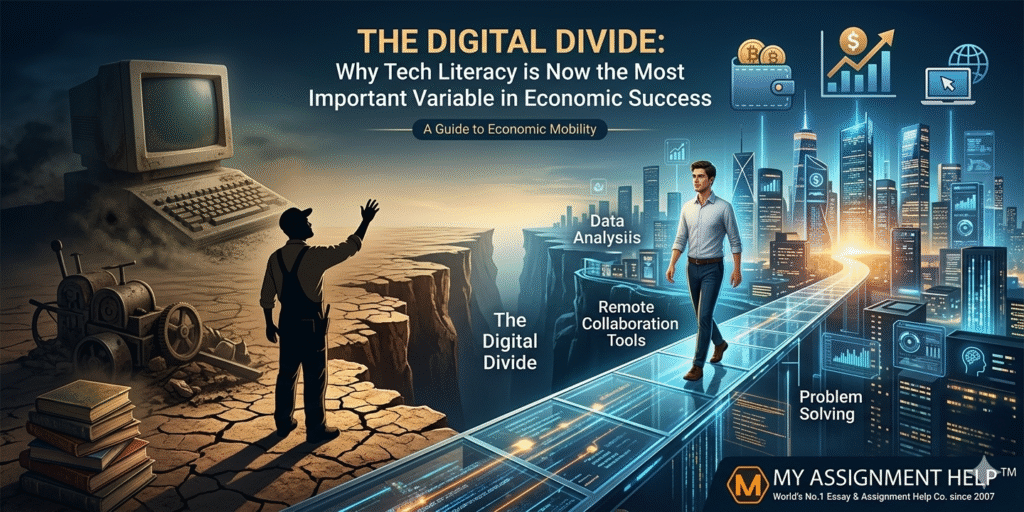
The global economy has undergone a fundamental shift. We have moved from the industrial age, where physical labor and machinery were the primary drivers of value, to the information age, where data, connectivity, and digital fluency dictate wealth. Today, technical literacy—defined as the ability to use, manage, understand, and assess technology—is no longer a “niche” skill reserved for IT professionals. It has become the single most significant variable in determining an individual’s, and a nation’s, economic trajectory.
In the United States, the correlation between digital proficiency and earnings is stark. According to research by the Brookings Institution, the “digitalization” of the American workforce has accelerated rapidly; since 2010, the number of jobs requiring high or medium levels of digital skills has jumped to nearly 90% of all new jobs created. Those who cannot navigate this landscape are increasingly sidelined, facing stagnating wages and job insecurity.
The Economic Engine: Connectivity and Career Growth
The modern workplace is an ecosystem of SaaS platforms, AI-driven analytics, and cloud-based collaboration tools. For students and professionals alike, mastering these tools is essential for survival. In academic circles, understanding the digital implications of global markets is now a core requirement. For instance, students exploring these trends often seek economics assignment help to better grasp how digital infrastructure impacts macroeconomic stability and labor market equilibrium.
This shift is not just about knowing how to use a smartphone; it is about “computational thinking.” It is the ability to leverage technology to solve complex problems. As automation and Artificial Intelligence (AI) continue to reshape industries, the labor market is bifurcating. On one side, we see high-skill workers who command premium salaries because they can interface with AI and data; on the other, we see a shrinking pool of low-tech roles that are highly susceptible to automation.
See also: Backyard Patio Renovation Ideas
Data-Driven Insights: The Cost of the Digital Gap
Recent data underscores the urgency of this transition:
- The Earning Gap: Workers with high digital skills earn roughly 47% more than those with no digital skills, according to a 2023 report by Amazon Web Services (AWS) and Gallup.
- Productivity Gains: Businesses that prioritize tech literacy among their staff report 25% higher productivity and faster innovation cycles.
- The Skills Gap: By 2030, it is estimated that 85 million jobs could go unfilled because there aren’t enough people with the digital skills to perform them (Korn Ferry).
From Classroom to Career: Building the Foundation
Economic success now begins with the ability to navigate digital information. Whether it is a student drafting a thesis or a researcher analyzing market trends, the quality of digital tools and professional support matters. Many high-achieving individuals rely on assignment writing services to refine their technical documentation and ensure their work meets the rigorous standards of today’s digital-first academic environment.
By integrating tech literacy into the educational and professional journey, individuals can transition from being passive consumers of technology to active creators. This agency is what drives upward mobility in a capitalist system that increasingly rewards efficiency and technological integration.
Key Takeaways
- Digital Fluency equals Wage Growth: High-level tech skills are directly correlated with significantly higher lifetime earnings.
- Automation Resilience: Tech-literate workers are better equipped to pivot when AI or robotics automate traditional tasks.
- The EEAT Factor: Economic authority in the modern age requires a foundation of Experience, Expertise, Authoritativeness, and Trustworthiness—all of which are amplified by the effective use of digital tools.
- Continuous Learning: Tech literacy is not a one-time achievement but a continuous process of adapting to new software and hardware paradigms.
Frequently Asked Questions (FAQ)
Q: Does tech literacy only apply to STEM jobs?
A: No. Even in “traditional” fields like healthcare, agriculture, and the arts, technology is used for record-keeping, precision farming, and digital marketing. Every sector is now a tech sector.
Q: How can I improve my tech literacy if I’m already in the workforce?
A: Focus on “micro-credentialing.” Short courses in data analytics, AI tools, or digital project management can provide immediate ROI on your skill set.
Q: Is the digital divide narrowing?
A: While access to hardware (phones/laptops) has increased, the “usage gap”—the difference in how effectively people use technology for economic gain—is actually widening.
Author Bio
Dr. Aris Thorne is a Senior Content Strategist at MyAssignmentHelp. With over 15 years of experience in educational consultancy and economic research, Dr. Thorne focuses on the intersection of technology and labor markets. He is a frequent contributor to academic journals on the evolution of E-E-A-T in digital content and is dedicated to helping students navigate the complexities of the modern digital economy.
References
- Brookings Institution (2023). “Digitalization and the American Workforce.”
- AWS & Gallup (2023). “The Economic Benefits of Tech Savvy Workers.”
- Korn Ferry (2022). “The Global Talent Crunch.”
- World Economic Forum (2024). “The Future of Jobs Report.